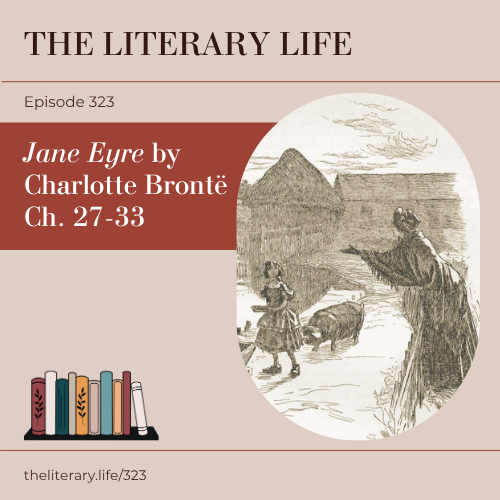
Episode 323: “Jane Eyre” by Charlotte Brontë, Ch. 27-33
Listen to The Literary Life:
This week on The Literary Life Podcast with Angelina Stanford and Thomas Banks, we continue our series on Charlotte Brontë’s Jane Eyre. In today’s episode, they talk about the main plot points and follow threads of meaning in chapters 27-33. Some of the ideas they discuss include Romanticism in literature, Rochester’s Byronic qualities, pictures of Jane’s awakening, the eucatastrophe in this section of the book, parallels to the story of Cupid and Psyche, and more contrasts between fire and ice.
You can check out all the latest offerings of mini-classes and webinars, both upcoming and recorded in the past. Find everything at HouseofHumaneLetters.com, where you can also sign up for the HHL newsletter to stay in the loop about all the latest happenings!
Commonplace Quotes:
I am always suspicious of a novelist’s theories; I have never known them to be anything other than a justification for his own shortcomings. So a writer who has no gift for the contrivance of a plausible story will tell you that storytelling is the least important part of the novelist’s equipment, and if he is devoid of humor he will tell you that humor is the death of fiction.
W. Somerset Maugham, from A Writer’s Notebook
Charlotte Brontë dedicated Jane Eyre to the author of Vanity Fair. I should hesitate to say that Charlotte Brontë’s is a better book than Thackeray’s, but I think it might well be a maintained that it is a better story. All sorts of inquiring asses (equally ignorant of the old nature of woman and the new nature of the novel) whispered wisely that George Eliot’s novels were really written by George Lewes. I will cheerfully answer for the fact that, if they had been written by George Lewes, no one would ever have read them.
The truth is, I think, that the modern novel is a new thing; not new in its essence (for that is the philosophy for fools), but new in the sense that it lets loose many of the things that are old. It is a hearty and exhaustive overhauling of that part of human existence which has always been the woman’s province, or rather kingdom; the play of personalities in private, the real difference between Tommy and Joe.
G. K. Chesterton, from The Victorian Age in Literature
Books and Links:
Amazon Affiliate links follow….
Easter Wings
by George Herbert
Lord, who createdst man in wealth and store,
      Though foolishly he lost the same,
            Decaying more and more,
                  Till he became
                        Most poore:
                        With thee
                  O let me rise
            As larks, harmoniously,
      And sing this day thy victories:
Then shall the fall further the flight in me.

My tender age in sorrow did beginne
      And still with sicknesses and shame.
            Thou didst so punish sinne,
                  That I became
                        Most thinne.
                        With thee
                  Let me combine,
            And feel thy victorie:
         For, if I imp my wing on thine,
Affliction shall advance the flight in me.
Support The Literary Life:
Become a patron of The Literary Life podcast as part of the “Friends and Fellows Community” on Patreon, and get some amazing bonus content! Thanks for your support!
Connect with Us:
You can find Angelina and Thomas at HouseofHumaneLetters.com, on Instagram @angelinastanford, and on Facebook at www.facebook.com/ANGStanford/
Follow The Literary Life on Instagram, and jump into our private Facebook group, The Literary Life Discussion Group, and let’s get the book talk going! http://bit.ly/literarylifeFB
Subscribe to The Lit Life:




You May Also Like

Episode 225: “Agnes Grey” by Anne Brontë, Ch. 6-11
Episode 326: “The Rape of the Lock” by Alexander Pope