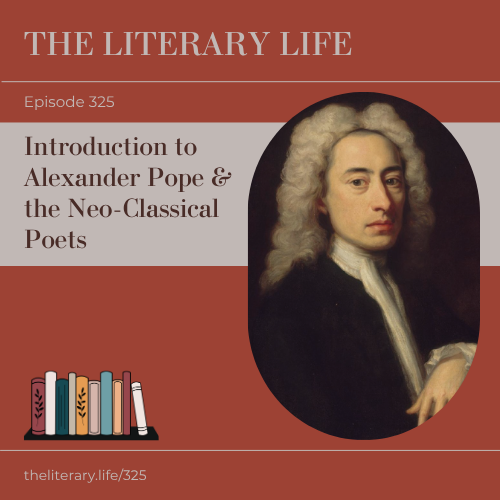
Episode 325: Introduction to Alexander Pope and the Neo-Classical Poets
Listen to The Literary Life:
Today on The Literary Life podcast, Angelina Stanford and Thomas Banks share an introduction to the Neo-Classical Poets, including Alexander Pope, and their poetry. First off, they establish a definition of the Neo-classical period both in terms of time and of culture. In addition, Angelina points out some ways in which the coming of the Enlightenment throws off ideals of the Medievals in favor of those of the Greeks and Romans. Another topic they highlight is the popularity of the satire in this period, as well as the prevelance of the printed word. After this general introduction to the period, Thomas shares a biographical sketch of Alexander Pope.
Join us back again here next week when we will discuss Pope’s mock epic poem, “The Rape of the Lock.”
You can check out all the latest offerings of mini-classes and webinars, including Jenn Roger’s webinar on C. S. Lewis’ The Pilgrim’s Regress, at HouseofHumaneLetters.com.
Commonplace Quotes:
Doesn’t it make you puke sometimes to see what they’re doing to England, with their plaster bird-baths and their plaster gnomes, and their pixies and tin cans, where the beechwoods used to be?
George Orwell, from Coming Up for Air
No notion was more characteristic of English neo-classicism than the idea that taste in the fine arts is an ally of morals. The eighteenth century believed that both the feeling or beauty and the prizing of what is decent and proper, perfect the character of the gentleman.
Samuel Kliger, from “Jane Austen’s Pride and Prejudice in the Eighteenth-Century Mode”
Books and Links:
The Pilgrim’s Regress by C. S. Lewis
Coming Up for Air by George Orwell
Gulliver’s Travels by Jonathan Swift
Pride and Prejudice by Jane Austen
Chapman’s Homer: The Odyssey by Homer, trans. by George Chapman
She Stoops to Conquer by Oliver Goldsmith
Cato by Joseph Addison
The Federalist Papers by Alexander Hamilton, James Madison, et al.
Common Sense by Thomas Paine
Moll Flanders by Daniel Defoe
Selection from “The Epistle to Doctor Arbuthnot”
by Alexander Pope
       Is there a parson, much bemus'd in beer,
A maudlin poetess, a rhyming peer,
A clerk, foredoom'd his father's soul to cross,
Who pens a stanza, when he should engross?
Is there, who, lock'd from ink and paper, scrawls
With desp'rate charcoal round his darken'd walls?
All fly to Twit'nam, and in humble strain
Apply to me, to keep them mad or vain.
Arthur, whose giddy son neglects the laws,
Imputes to me and my damn'd works the cause:
Poor Cornus sees his frantic wife elope,
And curses wit, and poetry, and Pope.
Support The Literary Life:
Become a patron of The Literary Life podcast as part of the “Friends and Fellows Community” on Patreon, and get some amazing bonus content! Thanks for your support!
Connect with Us:
You can find Angelina and Thomas at HouseofHumaneLetters.com, on Instagram @angelinastanford, and on Facebook at www.facebook.com/ANGStanford/
Follow The Literary Life on Instagram, and jump into our private Facebook group, The Literary Life Discussion Group, and let’s get the book talk going! http://bit.ly/literarylifeFB
Subscribe to The Lit Life:




You May Also Like

Episode 278: The Literary Life of Natalia Testa
Episode 51: Discussing Simone Weil’s Essay on Education