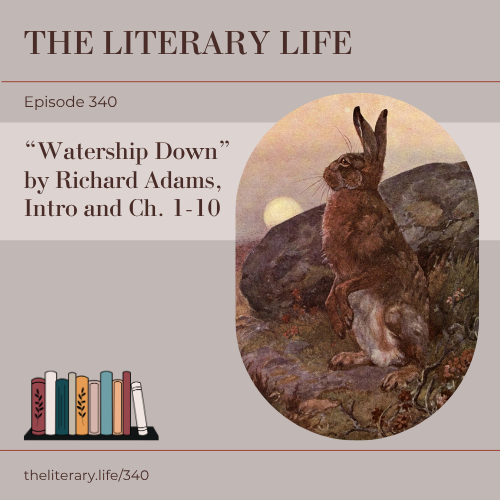
Episode 340: Watership Down by Richard Adams, Introduction, Ch. 1-10
Welcome back to The Literary Life Podcast and a new book discussion series! This month, Angelina and Thomas will be covering Richard Adams’ Watership Down. Beginning of their commonplace quotes, they talk about the background of this book and what type of story this is, as well as how Angelina is approaching this first read. Thomas gives some biographical information on Richard Adams, including the publishing challenges facing Adams. Angelina highlights the epigraphs beginning each chapter and their significance. Some of the other topics Thomas and Angelina share their thoughts about include the classical references in these chapters, the allegory of the journey of the soul, and the archetypes and obstacles that we may see in the rest of the book. Join us again next week for chapters 11-21!
Don’t forget to check out everything going on over at HouseofHumaneLetters.com to stay up to date on all the upcoming new summer classes and webinars.
Listen to The Literary Life:
Commonplace Quotes:
He is even said to have held burlesque series in his village church, preaching blasphemous sermons to a congregation of cats.
Charles Petrie, from “When Britain Saved Europe“
One of the most remarkable aspects of the book is that it is not one fine story, but simultaneously so many fine stories, so many types of stories. To a greater or lesser degree, Watership Down is a beast fable, a fantasy, a mythological tale, an epic, a political/Utopian novel, and an allegory. Richard Adams emerges not just as a storyteller but as a master teller of many types of stories.
Robert Miltner, from “‘Watership Down’: A Genre Study“
Afterwards
by Thomas Hardy
When the Present has latched its postern behind my tremulous stay,
And the May month flaps its glad green leaves like wings,
Delicate-filmed as new-spun silk, will the neighbours say,
“He was a man who used to notice such things?”
If it be in the dusk when, like an eyelid’s soundless blink,
The dewfall-hawk comes crossing the shades to alight
Upon the wind-warped upland thorn, a gazer may think,
“To him this must have been a familiar sight.”
If I pass during some nocturnal blackness, mothy and warm,
When the hedgehog travels furtively over the lawn,
One may say, “He strove that such innocent creatures should come to no harm,
But he could do little for them; and now he is gone.”
If, when hearing that I have been stilled at last, they stand at the door,
Watching the full-starred heavens that winter sees
Will this thought rise on those who will meet my face no more,
“He was one who had an eye for such mysteries?”
And will any say when my bell of quittance is heard in the gloom
And a crossing breeze cuts a pause in its outrollings,
Till they rise again, as they were a new bell’s boom,
“He hears it not now, but used to notice such things?”
Book List:
Amazon affiliate links below
Watership Down by Richard Adams
The Aeneid by Virgil
The Oresteian Trilogy: Agamemnon, The Choephori, The Eumenides by Aeschylus
Riki-Tiki-Tavi by Rudyard Kipling
Pilgrim’s Progress by John Bunyan
The Divine Comedy by Dante Alighieri
The Faerie Queene by Edmund Spenser
Support The Literary Life:
Become a patron of The Literary Life podcast as part of the “Friends and Fellows Community” on Patreon, and get some amazing bonus content! Thanks for your support!
Connect with Us:
You can find Angelina and Thomas at HouseofHumaneLetters.com, on Instagram @angelinastanford, and on Facebook at www.facebook.com/ANGStanford/
Follow The Literary Life on Instagram, and jump into our private Facebook group, The Literary Life Discussion Group, and let’s get the book talk going! http://bit.ly/literarylifeFB
Subscribe to The Lit Life:




2 Comments
Jon Eriksson
Please give me the link to the Malcolm Guite interview you mention in this episode.
And thank you very much for what you are doing in your podcast and courses, and your fresh perspective on genuine literary scholarship, in contrast to ideologically-driven interpretations of literature.
Your Christian perspective is also so refreshing and encouraging.
Keep going! Keep letting your Light shine!
Jon
admin
You can find our episode with Malcolm Guite here: https://www.theliterary.life/327-2/