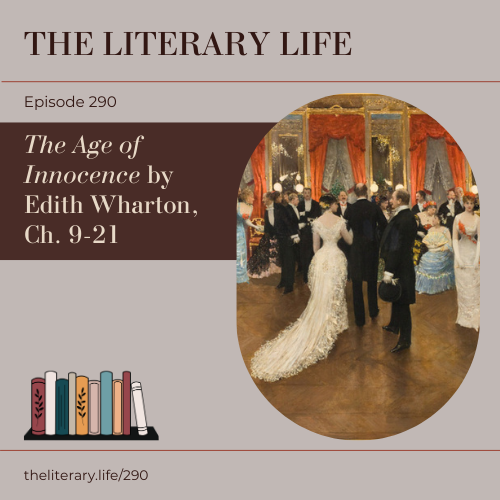
Episode 290: The Age of Innocence by Edith Wharton, Ch. 9-21
Welcome to The Literary Life Podcast and our series covering The Age of Innocence by Edith Wharton. Angelina and Thomas open with their commonplace quotes, then begin discussing the events and characters of this section of the book. Some of the ideas they build on this week are the challenges to social conventions, the many references to the goddess Diana and May’s “boyishness”, examples of the pretense of society, and the language of flowers. In addition, Thomas shares his feelings about the character of Newland Archer, and Angelina points out the recurring themes of love triangles throughout these chapters.
Join us next week when we finish up the last chapters of this book, then come back after that for an episode on the film adaptation of this book with our film guru, Atlee Northmore.
Visit the HouseofHumaneLetters.com to sign up for all the upcoming and past mini-classes and webinars taught by Angelina, Thomas, and their colleagues!

Listen to The Literary Life:
Commonplace Quotes:
It was easy to be clever, but hard to look into the face of God, who is found not so much by cleverness as by stillness.
Mark Helprin, from A Soldier of the Great War
What are the key-words of modern criticism? Creative, with its opposite derivative; spontaneity, with its opposite convention; freedom, contrasted with rules. Great authors are innovators, pioneers, explorers; bad authors bunch in schools and follow models. Or again, great authors are always “breaking fetters” and “bursting bonds”. They have personality, they “are themselves”. I do not know whether we often think out the implication of such language into a consistent philosophy; but we certainly have a general picture of bad work flowing from conformity and discipleship, and of good work bursting out from certain centers of explosive force–apparently self-originating force–which we call men of genius.
C. S. Lewis, from “Christianity and Literature”
Criterion
by Hilaire Belloc
When you are mixed with many I descry
A single light, and judge the rest thereby.
But when you are alone with me, why then,
I quite forget all women and all men.
Books and Links Mentioned:
Amazon affiliate links follow
The Picture of Dorian Gray by Oscar Wilde
The Portrait of a Lady by Henry James
Middlemarch by George Eliot
Support The Literary Life:
Become a patron of The Literary Life podcast as part of the “Friends and Fellows Community” on Patreon, and get some amazing bonus content! Thanks for your support!
Connect with Us:
You can find Angelina and Thomas at HouseofHumaneLetters.com, on Instagram @angelinastanford, and on Facebook at www.facebook.com/ANGStanford/
Follow The Literary Life on Instagram, and jump into our private Facebook group, The Literary Life Discussion Group, and let’s get the book talk going! http://bit.ly/literarylifeFB
Subscribe to The Lit Life:




You May Also Like

Episode 272: Best of Series – “The Enchanted April” by Elizabeth von Arnim, Ch. 1-11
Episode 176: The “Best of” Series – The Great Divorce, Ch. 2-6, Ep. 48