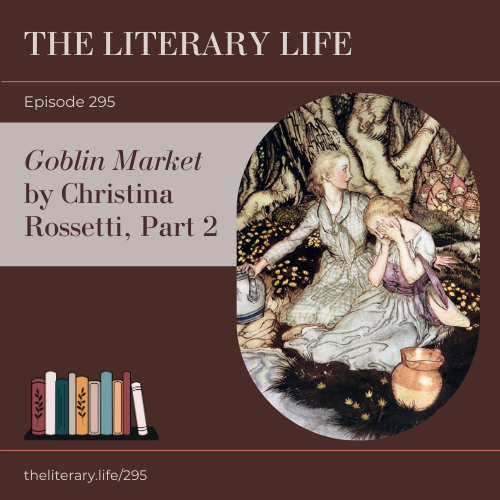
Episode 295: “Goblin Market” by Christina Rossetti, Part 2
Listen to The Literary Life:
Today on The Literary Life podcast Angelina Stanford and Thomas Banks continue their two-part series on Christina Rossetti’s narrative poem “Goblin Market.” They begin discussing this poem by connecting it with the larger conversation on art and the literary tradition, pointing out the flaws of modern ways of reading. Angelina emphasizes the importance of understanding this poem, as well as other classic works of fantasy, in terms of the fairy world and how symbolism and allegory work in fairy tales. After these preliminary thoughts, they go into more detail about this poem, including the obvious picture of the Fall, the vampire imagery, other Scriptural allusions, and the false versus the true Eucharist.
Join us back here next week for our Dracula series reboot and more examples of how to read well!
Visit the HouseofHumaneLetters.com to sign up for all the upcoming and past mini-classes and webinars taught by Angelina, Thomas, and their colleagues!
We are excited to announce this coming year’s annual Literary Life Online Conference, happening January 23-30, 2026, “The Letter Killeth, but the Spirit Quickeneth: Reading Like a Human”. Our speakers will be Dr. Jason Baxter, Jenn Rogers, Dr. Anne Phillips, and, of course, Angelina Stanford and Thomas Banks.
Commonplace Quotes:
Still Dunce the Second reigns like Dunce the First.
Alexander Pope, from “The Dunciad“
We do not mind being told that when we enjoy Milton’s description of Eden some latent sexual interest is, as a matter of fact, and along with a thousand other things, present in our unconscious. Our quarrel is with the man who says ‘You know why you’re really enjoying this?’ or ‘Of course you realize what’s behind this?’ or ‘It all comes from so-and-so.’ What we resent, in fact, is not so much the suggestion that we are interested in the female body as the suggestion that we have no interest in gardens: not what the wiseacre would force upon us, but what he threatens to take away. If it is true that all our enjoyment of the images, without remainder, can be explained in terms of infantile sexuality, then, I confess, our literary judgements are in ruins. But I do not believe it is true.
C. S. Lewis, from “Psycho-Analysis and Literary Criticism”
Books and Links:
Why Literature Still Matters by Dr. Jason Baxter
Selected Literary Essays by C. S. Lewis
The Princess and the Goblin by George MacDonald
To Any Reader
by Robert Louis Stevenson
As from the house your mother sees
You playing round the garden trees,
So you may see, if you will look
Through the windows of this book,
Another child, far, far away,
And in another garden, play.
But do not think you can at all,
By knocking on the window, call
That child to hear you. He intent
Is all on his play-business bent.
He does not hear; he will not look,
Nor yet be lured out of this book.
For, long ago, the truth to say,
He has grown up and gone away,
And it is but a child of air
That lingers in the garden there.
Support The Literary Life:
Become a patron of The Literary Life podcast as part of the “Friends and Fellows Community” on Patreon, and get some amazing bonus content! Thanks for your support!
Connect with Us:
You can find Angelina and Thomas at HouseofHumaneLetters.com, on Instagram @angelinastanford, and on Facebook at www.facebook.com/ANGStanford/
Follow The Literary Life on Instagram, and jump into our private Facebook group, The Literary Life Discussion Group, and let’s get the book talk going! http://bit.ly/literarylifeFB
Subscribe to The Lit Life:



You May Also Like
Episode 58: “Leaf by Niggle” by J. R. R. Tolkien, Part 1
Episode 120: A Midsummer Night’s Dream, Act III