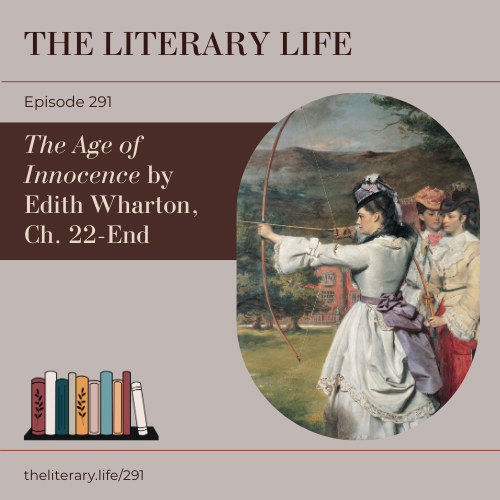
Episode 291: The Age of Innocence by Edith Wharton, Ch. 22-End
This week on The Literary Life Podcast we wrap up the book discussion portion of our series on Edith Wharton’s The Age of Innocence. Today, Angelina and Thomas begin with chapter 22, going through the significant scenes all the way to the end of the book. They talk about the ways in which this book is an elegy, as well as the continued glimpses of “the family” as the main character. They also discuss the ways in which May shows herself to be more cunning that she pretends in contrast to Ellen’s lack of pretense. Other topics of discussion are America’s relationship with foreign influence, Archer’s desire to live in an illusion, and the recurring theme of “Faust.” They conclude with some thoughts on this book as a parable of American culture.
Join us next week for an episode on the film adaptation of this book with our film guru, Atlee Northmore.
Visit the HouseofHumaneLetters.com to sign up for all the upcoming and past mini-classes and webinars, especially “The Viking World” taught by Dr. Michael Drout.

Listen to The Literary Life:
Commonplace Quotes:
It is at least as possible for a Philadelphian to feel the presence of Penn and Franklin as for an Englishman to see the ghosts of Alfred and Becket. Tradition does not mean a dead town; it does not mean that the living are dead but that the dead are alive. It means that it still matters what Penn did two hundred years ago or what Franklin did a hundred years ago; I never could feel in New York that it mattered what anybody did an hour ago.
G. K. Chesterton, from What I Saw in America
I think Christian Literature can exist only in the same sense in which Christian cookery might exist. It would be possible, and it might be edifying, to write a Christian cookery book. Such a book would exclude dishes whose preparation involves unnecessary human labour or animal suffering, and dishes excessively luxurious. That is to say, its choice of dishes would be Christian. But there could be nothing specifically Christian about the actual cooking of the dishes included. Boiling an egg is the same process whether you are a Christian or a Pagan. In the same way, literature written by Christian for Christians would have to avoid mendacity, cruelty, blasphemy, pornography, and the like, and it would aim at edification in so far as edification was proper to the kind of work in hand. But whatever it chose to do would have to be done by the means common to all literature; it could succeed or fail only by the same excellences and the same faults as all literature; and its literary success or failure would never be the same thing as its obedience or disobedience on Christian principles.
C. S. Lewis, from Christianity Reflections
“Ask Me No More”, from “The Princess”
by Alfred, Lord Tennyson
Ask me no more: the moon may draw the sea;
         The cloud may stoop from heaven and take the shape,
         With fold to fold, of mountain or of cape;
But O too fond, when have I answer'd thee?
                Ask me no more.

Ask me no more: what answer should I give?
         I love not hollow cheek or faded eye:
         Yet, O my friend, I will not have thee die!
Ask me no more, lest I should bid thee live;
                Ask me no more.

Ask me no more: thy fate and mine are seal'd:
         I strove against the stream and all in vain:
         Let the great river take me to the main:
No more, dear love, for at a touch I yield;
                Ask me no more.
Books and Links Mentioned:
Amazon affiliate links follow
Faust by Johann Wolfgang von Goethe
Support The Literary Life:
Become a patron of The Literary Life podcast as part of the “Friends and Fellows Community” on Patreon, and get some amazing bonus content! Thanks for your support!
Connect with Us:
You can find Angelina and Thomas at HouseofHumaneLetters.com, on Instagram @angelinastanford, and on Facebook at www.facebook.com/ANGStanford/
Follow The Literary Life on Instagram, and jump into our private Facebook group, The Literary Life Discussion Group, and let’s get the book talk going! http://bit.ly/literarylifeFB
Subscribe to The Lit Life:






One Comment
Megan Patrick
The Age of Innoncence was my first book with This Literary Life and it was a thoughtful and delightful experience. I’m so happy to have found you. Through the experience of reading AOI I came across a couple ideas I thought mixed well with the book. The first is a line a recently read from Stefan Zwieg’s “The World of Yesterday”, describing male and female romantic relationships of the period, “the man vigorous, chivalrous, and aggressive, the woman shy, timid and on the defensive—the hunter and his prey, instead of their being equal.” It seems that Wharton turns this paradigm on his head. The second thought that has merged with me in AOI is Rilke’s poem:
“Sometimes a man stands up during supper
and walks outdoors, and keeps on walking,
because of a church that stands somewhere in the East.
And his children say blessings on him as if he were dead.
And another man, who remains inside his own house,
stays there, inside the dishes and in the glasses,
so that his children have to go far out into the world
toward that same church, which he forgot.” It has seemed to me that Newland stayed with the dishes & glasses. In any case, thank you so much Angelina and Thomas for the work you put out into the world. I’m really excited about exploring your classes this fall.