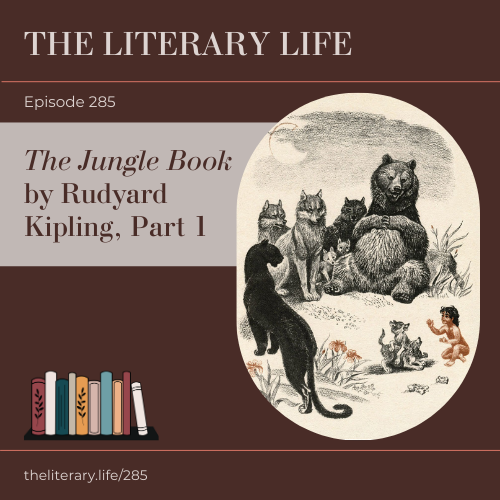
Episode 285: The Jungle Book by Rudyard Kipling, “Mowgli’s Brothers”
Today on The Literary Life podcast, we begin a new series of episodes on The Jungle Book by Rudyard Kipling with our hosts Angelina Stanford, Cindy Rollins, and Thomas Banks! After sharing their commonplace quotes, each of them talks about their own reading histories with Rudyard Kipling’s work. Thomas gives us some biographical information about Kipling and sets up the literary period in which he wrote. They then begin talking about the structure and form of this book as it is set up as a series of short stories as beast fables. Angelina shares some of the mythic and fairy tale elements she noticed while reading this first story, “Mowgli’s Brothers.” They also discuss some of the challenges we face reading stories written in a different time and place without imposing our current views on all the literature of the period.
Check out this year’s Back to School Online Conference, “Educating the Freeborn,” over at MorningTimeforMoms.com to get registered and hear all of this year’s amazing speakers!
Listen to The Literary Life:
Commonplace Quotes:
He assumes that the whole of the body, and thus the whole of the person, is engaged in the act of reading. Words are tasted to release their full flavor, weighed in order to sound the full depths of their meaning. It is not only that it was customary to pronounce the words with the lips in a low tone so that they were heard as well as seen; they were also learnt by heart in the fullest sense of that phrase, which again we have lost, but which means with the whole being. So the scriptures are mouthed by the lips, understood by the intelligence, fixed by the memory, and finally, the will comes into play, and what has been read is also put into practice. The act of reading makes the reader become a different person. Reading cannot be separated from living.
Esther de Waal, from Seeking God
Pleasant it is for little tin gods/When great Jove nods;/But little tin gods make their little mistakes/In missing the hour when great Jove wakes.
Rudyard Kipling, Little Tin Gods
If we universalize these attitudes, as though they were Platonic realities, and assume that they have a validity for all time, we turn history into a mirror which is of significance to us only insofar as we may perceive in it what appear to be foreshadowings of ourselves, but which are, actually, merely reflections of ourselves arising from reconstructions of the evidence based on our own values. And when this happens, history, although it may seem to flatter us with the consoling message, “Thou art the fairest of all,” becomes merely an instrument for the cultivation of our own prejudices. We learn nothing from it that we could not learn from the world around us.
D. W. Robertson, from A Preface to Chaucer
To R. K.
by James Kenneth Stephen
Will there never come a season
Which shall rid us from the curse
Of a prose which knows no reason
And an unmelodious verse:
When the world shall cease to wonder
At the genius of an Ass,
And a boy's eccentric blunder
Shall not bring success to pass:

When mankind shall be delivered
From the clash of magazines,
And the inkstand shall be shivered
Into countless smithereens:
When there stands a muzzled stripling,
Mute, beside a muzzled bore:
When the Rudyards cease from kipling
And the Haggards Ride no more.
Books Mentioned:
Amazon Affiliate links follow
Seeking God by Esther De Waal
A Preface to Chaucer by D. W. Robertson
Captains Courageous by Rudyard Kipling
101 Famous Poems edited by Roy C. Cook
Just So Stories by Rudyard Kipling
Stalky and Co. by Rudyard Kipling
Kim by Rudyard Kipling
The Pancatantra by Visnu Śarma, trans by Chandra Rajan
Jātaka Tales of the Buddha by Ken and Visakha Kawasaki
The Adventures of Tom Sawyer by Mark Twain
The Princess and the Goblin by George MacDonald
Raj Quartet by Paul Scott
Support The Literary Life:
Become a patron of The Literary Life podcast as part of the “Friends and Fellows Community” on Patreon, and get some amazing bonus content! Thanks for your support!
Connect with Us:
You can find Angelina and Thomas at HouseofHumaneLetters.com, on Instagram @angelinastanford, and on Facebook at www.facebook.com/ANGStanford/.
You can find Cindy Rollins at MorningTimeforMoms.com, over on her podcast The New Mason Jar, and on Facebook at https://www.facebook.com/CindyRollinsWriter. You can also check out her Patreon for additional content.
Follow The Literary Life on Instagram, and jump into our private Facebook group, The Literary Life Discussion Group, and let’s get the book talk going! http://bit.ly/literarylifeFB
Subscribe to The Lit Life:





3 Comments
Jessica
We are so excited you are doing the Jungle Book! My six-year-old daughter LOVES the Jungle Book. She has listened to it countless times. It’s a favorite she always goes back to. I had never read it before and I was so impressed the first time we listened to it. It is also now one of my favorites. She was excited when I told her that mommy’s podcast was going to be talking about her favorite book, so she actually listed to the first episode with me. But she did want me to pass on that she learned in her audio story introduction that Kipling said to pronounce Mowgli so that it rhymes with Cow. I wondered if this was accurate, and according to the Kipling Society website, my little six-year-old daughter was correct. https://www.kiplingsociety.co.uk/readers-guide/rg_junglebook_names.htm
Tricia Froyd
Do y’all have a link for the C.S. Lewis essay on Kipling that Thomas and Angelina both mentioned? I’d love to read it.
admin
The essay is titled “Kipling’s World” and can be found in Lewis’ “Selected Literary Essays.” https://amzn.to/4pEul7x